Why Your Plants Aren’t Growing
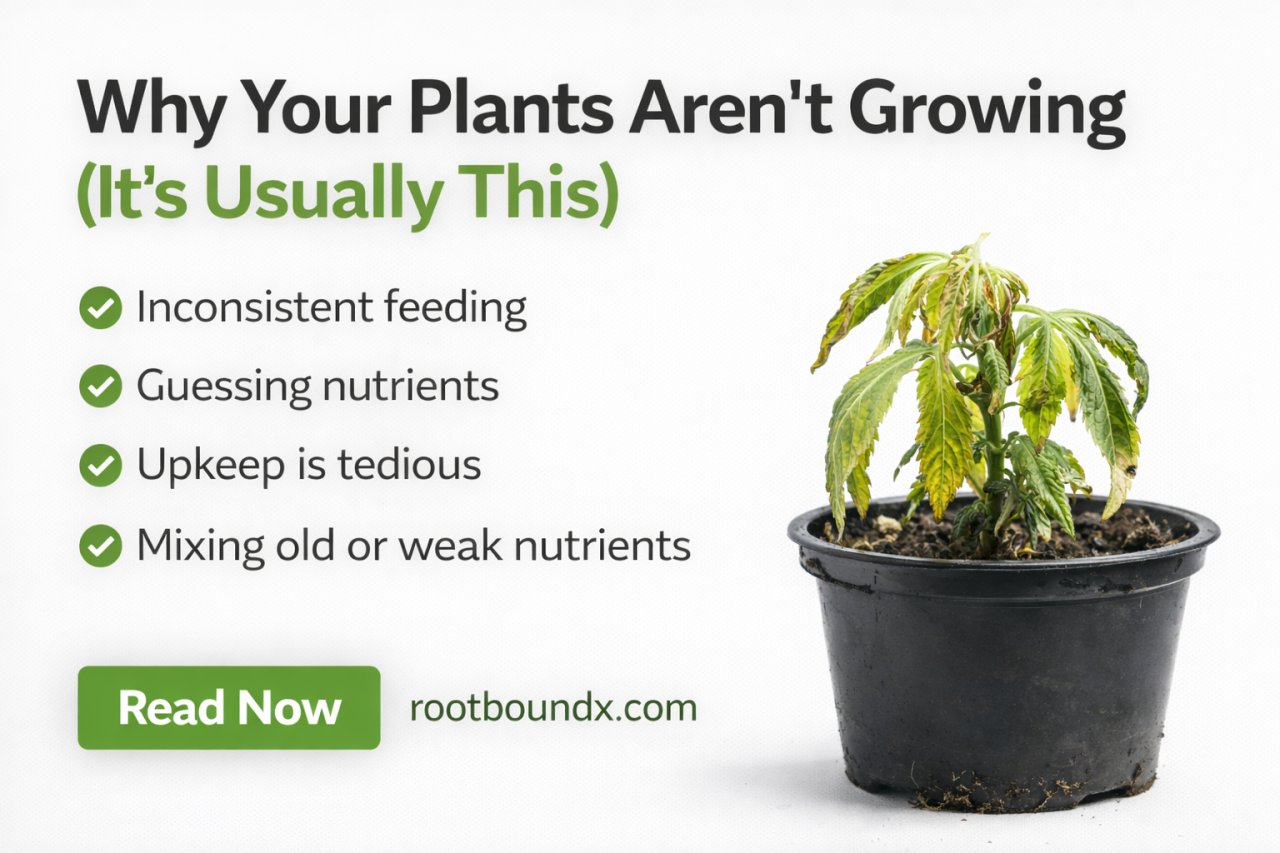
Why Your Plants Aren’t Growing
Most problems come down to a few controllable variables
If plant growth is slow, stalled, or inconsistent, the issue is rarely random. In hydroponics and controlled feeding, plant performance tracks directly with input quality and consistency.
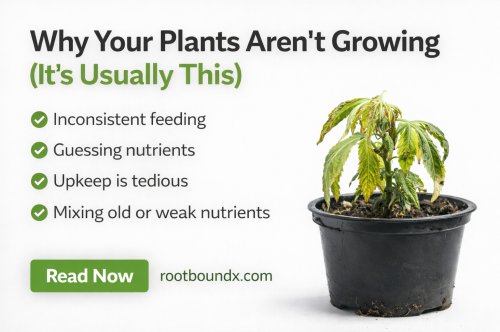
1. Inconsistent feeding
Plants respond to concentration. If nutrient strength changes day to day, growth slows. This happens when measurements are not precise or mixing is inconsistent.
- Different scoop amounts
- Uneven dissolving
- Changing ratios
2. Weak nutrient solution
Many growers underfeed without realizing it. Low concentration reduces available nitrogen, potassium, and phosphorus, limiting growth rate.
3. Poor input quality
Not all fertilizers deliver the same usable content. Low-quality or filler-heavy inputs reduce effective nutrient availability per gram.
4. Mixing errors
Certain nutrients must be dissolved separately. Combining incompatible salts in dry form can reduce availability.
- Calcium + phosphates = precipitation risk
- Calcium + sulfates = reduced solubility
5. No repeatable system
Growth improves when feeding is repeatable. Without a consistent formula, results vary and problems are harder to diagnose.
What working systems have in common
Hydroponics vs soil impact
In hydroponics, errors show immediately because there is no buffering medium. In soil, problems take longer to appear but still originate from the same causes.
Correction approach
- Standardize your nutrient recipe
- Measure by weight, not volume
- Use consistent mixing order
- Maintain stable feeding strength
RootboundX
RootboundX focuses on clean, water-soluble nutrients that allow precise feeding and repeatable results.
hydroponic nutrients, plant growth problems, diy nutrients, water soluble fertilizer, rootboundx